
Shower leaks, decrease in value, aesthetically displeasing; Why pre-made, acrylic, shower pans are cheaper initially, but more costly in the long run.
I’ll admit it, I have a love, hate relationship with pre-made acrylic pans. They allow for me to be of service to my customers, bring me work, and for me to support my family. However, I have good reasons to despise these shower pans. Of course I’m biased, I’m a #tilecontractor, so there’s that. First, they’re unpleasant to look at against beautifully tiled walls. I have encountered many a high priced bathroom brought down in value by these eyesores . Picture this… a nicely tiled shower; looks sharp, looks high-end, then your eye is brought down to the floor and you see a cheap-looking acrylic pan. Second, in terms of longevity, they‘re lacking. Many of them become discolored (no matter what the manufacturers say), scratched, and break down over time. Acrylic shower pans are what a majority of contractors throw down in order to save time and money. Home builders cut a good number of corners in the construction of showers, in order to cut costs and to be able to move on to the next project. It takes a true professional, and craftsman, to install a shower correctly and beautifully. Many builders just throw cheap labor at it; ultimately, skilled labor ain’t cheap, and cheap labor ain’t skilled. But I digress…
Often, the #prefab (pre-fabricated) acrylic pans are not installed correctly. It’s a favorite method of homebuilders and amateurs in the form of just placing drywall or cement board on top of the pan, in front of the outside tabs to keep water at bay, add caulk to the bottom seam, and call it a day. That's not a recipe for success here. Caulk, in and of itself, is not the end-all-be-all of waterproofing. It’s often a first line of defense, not your whole defense against water. Quality #caulk in the form of a sealant, used in conjunction with an industry-standard material and method of #waterproofing is certainly preferred. Such as #Schluter #Kerdi with sealant and banding, or #GoBoard or #Wedi with their respective sealants, are great methods to waterproof a shower. These products are entirely water proofed materials that won’t absorb water nor allow wicking up the wall. This way, problems such as cracking, disappearing grout and moldy caulk wont be an issue. Also these problems grow into leaks which lead into greater remediation involved with the subfloor, and drywall (not only on the shower walls but also the drywall beneath the shower pan on the floor below). Homebuilders generally do not use those types of materials because they are costly, timely and it takes certain knowledge, and experience to install correctly,
In short, when given the choice between a pre-fab pan and a tiled shower floor, I would suggest the tiled floor. I believe that inevitably, pre-made pans break down, and cause leaks. Spending a little bit more money for a tile floor will save a great deal of money in the long run; extensive repairs or whole shower replacement, could ultimately be in your future if not.
Below is an example of a recent project in which I had to replace a pre-made shower pan because of discoloration and a chronic #mold issue around the bottom seam of the pan. Water was getting caught behind the caulk, and #wicking up the substrate behind the tile. The moisture behind the tile was causing the discoloration or the #grout and caulk seams, and making a breeding ground for black mold. We remediated the problem by removing the first row of tile, and ripping out the old pan. Then, we replaced the lower walls with a #Schluter pan and water proof substrate, and installed the tile and grout application. This is now a shower pan that won't allow water wicking and moist areas that would cause mold growth. End result, fundamentally sound floor, aesthetically pleasing to view, cohesiveness and added equity in your bathroom.

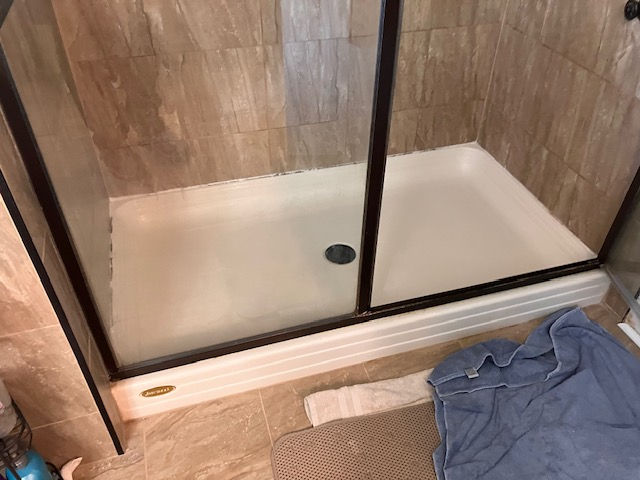


Here's a clear before and after...
#prefabpans #faithfultile #showerleak #mold #discoloration #Schluter #Kerdi #GoBoard #bathroom #tile #homeequity #tiledesign #homerepair #showerrepair #tilecontractor #waterleak

Comments